A total solar eclipse will be visible from parts of mainland Western Europe on Wednesday, marking the first such event in the region since 1999.
The Moon’s umbral shadow will cross northern Siberia, the Arctic Ocean and eastern Greenland before moving over western Iceland and reaching northern Spain. The path will briefly touch northeastern Portugal before ending at sunset over Spain’s Mediterranean coast and the Balearic Islands.
The maximum totality will occur over the North Atlantic, west of Iceland.
In Reykjavík, Iceland, totality will begin at about 5:48 p.m. local time (15:48 GMT). Parts of northern Spain, including A Coruña and Bilbao, will experience totality shortly before sunset, beginning at around 8:28 p.m. local time (18:28 GMT) in northwestern Spain.
However, Madrid and Barcelona will experience only a partial solar eclipse, as will most other parts of Europe.
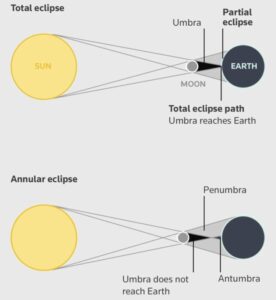
A solar eclipse occurs when the Moon passes between the Earth and the Sun, temporarily blocking sunlight. Whether the eclipse is total or annular depends largely on the Moon’s distance from Earth.
Because the Moon’s orbit around the Earth is elliptical rather than perfectly circular, its apparent size in the sky varies.
A total solar eclipse occurs when the Moon is closer to Earth and appears large enough to completely cover the Sun. During totality, daylight can briefly give way to darkness, temperatures may drop and stars can become visible.
The period of totality also allows observers to see the Sun’s outer atmosphere, known as the corona, without the bright solar disc obstructing the view.
Outside the narrow path of totality, a partial solar eclipse will be visible across much of the Northern Hemisphere.
Observers in several European countries, including the United Kingdom, Ireland, France and Italy, will see the Moon cover a significant portion of the Sun before sunset.
Northwestern Africa will also experience a deep partial eclipse, while parts of North America, including northern and eastern Canada, Alaska and the northern United States, will see the eclipse partially.
Experts have warned that proper solar viewing glasses are required throughout the eclipse, as looking directly at the Sun can cause serious eye damage.
Following Wednesday’s event, the next total solar eclipses will be visible in Australia and New Zealand in 2028, southern Africa in 2030 and Japan in 2035.
Totality will return to North America in 2044, when the Moon’s shadow will cross western Canada and the western United States.
Another major total solar eclipse will follow in 2045, with the path of totality crossing Canada and the United States from coast to coast.
For Western Europe and northwestern Africa, the eclipse will still be in progress at sunset.
The United Kingdom will not experience another total solar eclipse until 2090, while France’s next total eclipse is expected in 2081. Germany will have to wait until the next century.
The 2026 eclipse is the first of three successive solar eclipses that will be visible from Spain.
It will be followed by another total solar eclipse on August 2, 2027. The path of totality will cross southern Spain before moving across Morocco, Algeria, Tunisia, Libya, Egypt, Saudi Arabia and Yemen.
An annular solar eclipse will then be visible from Spain on January 26, 2028.
Unlike a total eclipse, an annular solar eclipse occurs when the Moon is farther from Earth and appears slightly smaller than the Sun.
As it passes across the Sun, it fails to cover the solar disc completely, leaving a bright ring of sunlight commonly known as the “ring of fire.”
The sky becomes noticeably darker during an annular eclipse, but it does not become completely dark as it does during totality.
After Spain’s 2028 event, no annular solar eclipses will cross Europe for several years. The next events will instead pass over Australia, followed by southern Africa and parts of the Middle East during the 2030s.