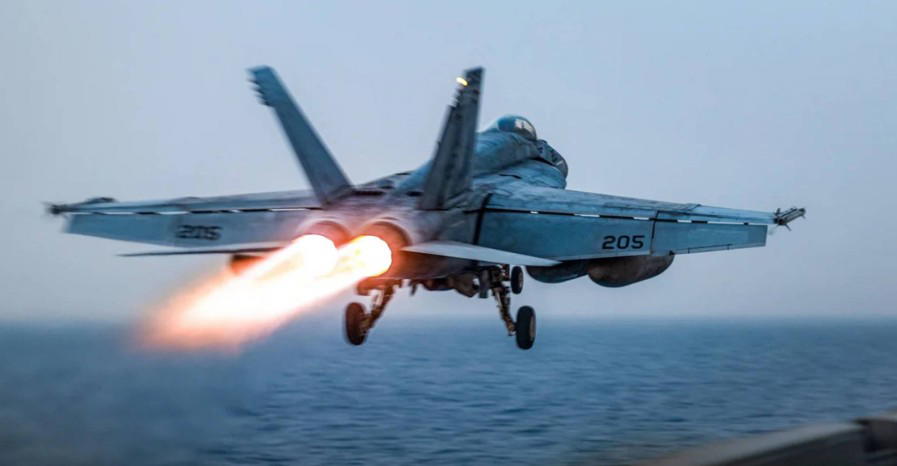
The United States launched extensive strikes on Iran over attacks on ships in the vital Strait of Hormuz, triggering a wave of reprisals Wednesday that Iran’s Guards said targeted US bases in the Gulf.
Both sides reported hitting dozens of targets in renewed hostilities, which have placed fresh strain on an interim deal to end the Middle East war and pushed oil prices to their highest level in two weeks.
Washington revoked sanction waivers on Iranian oil sales and launched the new attacks on military sites in what the US military called retaliation for Iran’s strikes on three commercial ships in Hormuz.
Iranian state media reported a wave of explosions around the strait, including six on the island of Qeshm, seven in the city of Sirik and more in the major port city of Bandar Abbas.
Iran’s threatened reply came quickly, with the Revolutionary Guards (IRGC) saying they had hit dozens of US military facilities in Bahrain and Kuwait, in a statement carried by state broadcaster IRIB.
US Central Command (CENTCOM) said its forces had struck over 80 targets, including Iranian air defence systems, coastal radar sites and 60 IRGC small boats.
The strikes aimed “to degrade Iran’s ability to continue attacking international commerce flowing through the international trade corridor”, it said.
Iran’s chief negotiator Mohammad Bagher Ghalibaf accused the United States of “major” breaches of their memorandum of understanding, including by reinstating oil sanctions and “violating Iranian adjustments in the Strait”.
Early on Wednesday, Bahrain’s interior ministry and the Kuwaiti army both reported their air defence systems were triggered, but did not offer details of any possible damage.
The US strikes came shortly after Washington revoked a temporary sanctions waiver for Iranian oil, raising pressure on Tehran as it negotiates over a final settlement to the conflict.
The US Treasury Department cancelled a license announced in June that had allowed Iran to produce, sell and deliver crude oil and related products through August 21.
“Iran’s actions in the Strait were wholly unacceptable to the United States and will be met with consequences,” a US official told AFP.
The official, speaking on condition of anonymity, said the US-Iran memorandum of understanding was “entirely performance-based”, warning that Tehran would see benefits only if it showed “good behaviour”.
But US negotiators were continuing to work “in good faith towards a final deal”, the official said.
– Hormuz attacks –
British maritime security agency UKMTO said Tuesday an “unknown projectile” hit a tanker near Hormuz, causing a fire, before two more vessels were struck, at least one by a drone.
CENTCOM identified the ships as the Marshall Islands-flagged Al Rekayyat, the Saudi Arabia-flagged Wedyan and the Liberia-flagged Cyprus Prosperity.
All three vessels were struck close to Oman, which had proposed a temporary transit corridor hugging its coastline — an initiative opposed by Iran as it seeks to impose fees on ships using the narrow waterway.
The Al-Rekayyat is Qatari, and Doha denounced the “unacceptable” attack on international maritime navigation and summoned Iran’s deputy ambassador to lodge a complaint.
Iran voiced “dismay” over Qatar’s accusations in a statement carried by state news agency IRNA, calling the claims “unacceptable.”
Oil prices jumped more than two percent in early Asian trade on Wednesday to hit their highest levels in two weeks, as the renewed attacks reignited worries over global energy supplies and cast doubt on the durability of the US-Iran agreement.
“We are now in a sensitive period where potential alternatives to an Iranian toll or fee system are being explored,” Andreas Krieg, a security expert at King’s College London, told AFP.
“Iran is sending a clear signal that no alternative will be accepted.”
Krieg said tankers trying to divert through the Omani maritime corridor without registering with Iran would be punished, and called the attacks a “clear violation” of the ceasefire agreement and international law.
Maritime traffic had tentatively resumed after Washington and Tehran signed the memorandum last month, but Iran has insisted there will be no return to pre-war arrangements, under which vessels could pass freely through the strait.
Under the 14-point US-Iran memorandum, Iran and Oman, which border Hormuz, must hold talks “to define the future administration and maritime services” in the waterway with other Gulf states.
Qatar had previously refused to mediate under Iranian fire as Tehran launched an unprecedented aerial bombardment against Gulf states in retaliation for the US-Israeli strikes.
But Doha has since taken a more active role, hosting indirect talks between Iran and the United States last week.